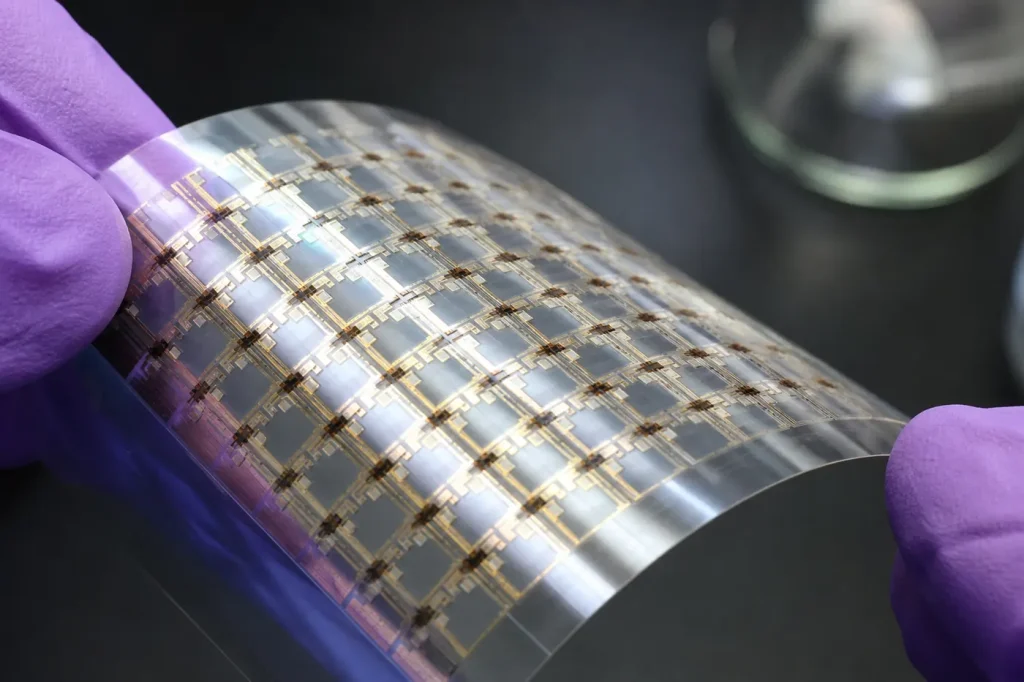
Organic semiconductors are carbon-based molecules and polymers with conjugated bonds, a pattern of alternating single and double bonds that lets electrons move along and between molecules. They conduct far less well than silicon, but they can be printed, bent and processed below about 150 °C. Start here for OLEDs, OFETs, organic solar cells and their limits.
Key numbers at 300 K
Organic semiconductors are a family of thousands of compounds, not one material. The values below are typical ranges and depend on the specific molecule or polymer, its purity and how the film is deposited. Crystalline silicon is shown for comparison.
| Property | Organic semiconductors (typical range) | Crystalline silicon (300 K) | Why it matters |
|---|---|---|---|
| Optical bandgap (eV) | ~1.5–3 | 1.12 (indirect) | Sets emission colour in OLEDs and absorption in solar cells |
| Carrier mobility (cm²/V·s) | ~10−6 to ~10; up to ~20 in the best single crystals | ≤1,400 (electrons), ≤450 (holes) | Limits transistor speed and current |
| Relative permittivity | ~3–4 | 11.7 | Low permittivity binds electrons and holes into excitons |
| Exciton binding energy | ~0.1–1 eV | ~15 meV | Organic solar cells need an interface to split excitons |
| Charge transport | Hopping between molecules in disordered films; band-like only in the best crystals | Band transport | Explains the low and temperature-sensitive mobility |
| Processing temperature | Room temperature to ~150 °C (printing, coating, evaporation) | Above 1,000 °C for crystal growth and oxidation | Allows plastic and flexible substrates |
| Thermal conductivity (W/m·K) | ~0.1–1 | 130–150 | Heat removal is poor in organic devices |
What are organic semiconductors?
In a conjugated molecule, overlapping p-orbitals on carbon atoms form a delocalized π-electron system. The highest occupied molecular orbital (HOMO) and lowest unoccupied molecular orbital (LUMO) play the role of the valence and conduction band edges, and the gap between them sets the optical and electrical behaviour.
There are two main groups. Small molecules such as pentacene, rubrene and the fullerene C60 are usually evaporated in vacuum or grown as crystals. Conjugated polymers such as P3HT (poly(3-hexylthiophene)) are dissolved and printed or spin-coated. In both cases the molecules are held together by weak van der Waals forces, not the covalent bonds of a silicon crystal. That is the root of both their flexibility and their low mobility. Start with the introduction to organic semiconductors, their characteristics and properties and how they are designed and synthesized.
How does their mobility compare with silicon?
It is lower by two to nine orders of magnitude, depending on how ordered the material is:
- Amorphous polymer films: about 10−6 to 10−3 cm²/V·s.
- Semicrystalline polymers and small-molecule thin films: roughly 10−2 to a few cm²/V·s. Polycrystalline pentacene films are a common benchmark near 1 cm²/V·s.
- Single crystals: rubrene and similar crystals reach about 10–20 cm²/V·s.
- For comparison: hydrogenated amorphous silicon (a-Si:H), long used in display backplanes, sits near 1 cm²/V·s. Crystalline silicon reaches 1,400 cm²/V·s for electrons.
The practical benchmark is therefore amorphous silicon, not crystalline silicon. The best organic films now match or beat a-Si:H, which is enough for display pixels, sensors and simple logic, but far short of processors. Our organic vs inorganic comparison covers the full trade-off, and the OFET guide explains how mobility is measured in transistors.
What devices use organic semiconductors?
Three device types matter:
- OLEDs (organic light-emitting diodes). The commercial success. OLED displays are standard in smartphones and sold in TVs, watches and laptops. The emissive layers are organic, while the pixel-driving transistors in the backplane are still silicon or metal-oxide.
- OFETs (organic field-effect transistors). Used in research and niche products such as flexible sensors, labels and printed circuits, where low processing temperature matters more than speed.
- OPVs (organic photovoltaics). Organic solar cells are lightweight and can be semi-transparent or tuned for indoor light. Lab efficiencies have improved markedly with newer non-fullerene acceptor molecules, but they still trail silicon and perovskite cells on efficiency and lifetime.
See OLEDs, organic solar cells and the wider applications guide.
What limits their lifetime?
Organic semiconductors degrade faster than inorganic ones, and the causes are well understood. Oxygen and water react with excited molecules, especially under light, and create traps that kill both emission and mobility. Heat and electrical stress change film morphology over time. In OLEDs, blue emitters are the weakest link because their high photon energy drives the most damaging chemistry.
Manufacturers manage this with thin-film or glass encapsulation, careful material purification and device designs that lower the stress on each molecule. Lifetime, along with batch-to-batch variability and contact resistance, is the main research focus. Read the pros and cons and current research challenges. For how organics sit against crystalline compounds, see compound semiconductor basics and the perovskites and quantum dots hub.
Start here
- Introduction to Organic Semiconductors Unveiled: A Comprehensive Guide to the Future of Electronics
- Comparison of Organic Semiconductors with Inorganic Semiconductors
- Organic Light Emitting Diodes (OLEDs)
- Organic Field-Effect Transistors (OFETs): Revolutionizing Electronic Device Technology
All organic semiconductor guides
Fundamentals
- Introduction to Organic Semiconductors Unveiled: A Comprehensive Guide to the Future of Electronics
- Unlocking the Secrets of Organic Semiconductors: Characteristics and Properties Unleashed
- Design and Synthesis of Organic Semiconductors: A Blueprint to Futuristic Electronics
- Organic Semiconductors: Reshaping Electronic Devices for a Sustainable Future
Trade-offs and limits
- Comparison of Organic Semiconductors with Inorganic Semiconductors
- Weighing the Pros and Cons: The Advantages and Disadvantages of Organic Semiconductors
- Advancing Beyond Barriers: Future Directions and Challenges in Organic Semiconductor Research
Devices and applications
- Organic Light Emitting Diodes (OLEDs)
- Organic Field-Effect Transistors (OFETs): Revolutionizing Electronic Device Technology
- The Bright Future of Organic Solar Cells (OSCs): Breaking Down Efficiency Barriers
- Revolutionizing Electronics: The Expansive Applications of Organic Semiconductors in Electronic Devices
Semiconductor fundamentals
- Understanding the Basics of Compound Semiconductors
- What is a Compound Semiconductor
- What Are III-V Semiconductors? Members, Properties and Uses
- What Is a Wide-Bandgap Semiconductor?
- Semiconductors Examples
Quick answers
- What materials are semiconductors?
- What are types of semiconductor?
- What is a semiconductor made of?
- What are examples of compound semiconductors?
- What are the advantages of compound semiconductors?
Related hubs
- All materials
- 2D semiconductors
- Perovskites, quantum dots and nanomaterials
- Semiconductor comparisons
Frequently asked questions
Are organic semiconductors the same as conductive polymers?
They are related. Conjugated polymers become highly conductive when heavily doped, the discovery recognized by the 2000 Nobel Prize in Chemistry (Heeger, MacDiarmid and Shirakawa). Undoped or lightly doped, the same class of materials behaves as a semiconductor.
Why do organic solar cells need two materials?
Light creates tightly bound excitons, with binding energies of roughly 0.1–1 eV, instead of free carriers. A donor and an acceptor material are blended so that excitons reach an interface where the energy offset splits them into free electrons and holes.
Can organic transistors replace silicon in processors?
No. Even the best organic crystals have about 1/70 of crystalline silicon’s electron mobility, and disordered films are up to a billion times lower. They compete with amorphous silicon and metal-oxide transistors in large-area, flexible and low-cost electronics.
Sources
- A. Köhler and H. Bässler, Electronic Processes in Organic Semiconductors: An Introduction, Wiley-VCH (2015).
- W. Brütting and C. Adachi (eds.), Physics of Organic Semiconductors, 2nd ed., Wiley-VCH (2012).
- M. Pope and C. E. Swenberg, Electronic Processes in Organic Crystals and Polymers, 2nd ed., Oxford University Press (1999).
- Ioffe Institute, New Semiconductor Materials (NSM) archive: Si property page (reference values). http://www.ioffe.ru/SVA/NSM/Semicond/