Marvell agreed on Nov. 2, 2026 to acquire Lumentum in an all-stock deal that values Lumentum at about $115 billion in implied enterprise value. Lumentum holders will receive 4.500 Marvell shares per Lumentum share. The companies expect the deal to close in the first half of 2028, subject to approvals.
What happened
According to Marvell’s Nov. 2 release, the fixed exchange ratio implies about $1,132 per Lumentum share, a 23.9% premium to the unaffected Oct. 28, 2026 share price. The $115 billion figure is enterprise value. Bloomberg puts the equity value at about $102.6 billion. A Lumentum internal email filed with the SEC as a Form 425 cites about $100 billion.
Other terms, per the release:
- Ownership after closing: about 67% Marvell holders, 33% Lumentum holders.
- Synergy target: more than $1 billion in annual run-rate cost synergies.
- Board: three Lumentum directors, including CEO Michael Hurlston, join Marvell’s board.
- Timing: close expected in the first half of 2028, subject to approvals.
Marvell’s release frames the deal around optical interconnect for AI infrastructure. It discusses the limits of copper and describes optics moving “within advanced semiconductor packages.” The release does not use the phrase “co-packaged optics.”
Why it matters for indium phosphide and optical materials
This section is CS Fusion’s analysis, not Marvell’s stated rationale.
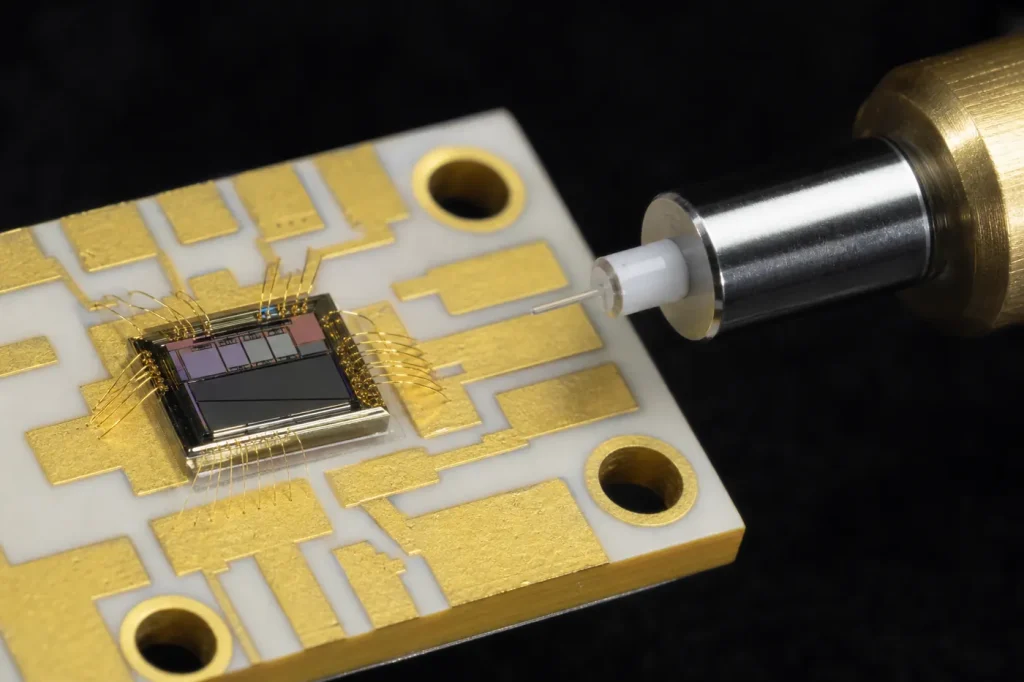
Lumentum is best known as an optical component maker, and its laser business rests on III-V compound semiconductors, chiefly indium phosphide (InP). InP matters here for a physics reason. Silicon has an indirect bandgap of 1.12 eV and does not emit light efficiently. InP and its alloys, such as InGaAsP, have direct bandgaps that can be tuned to emit at 1.3 µm and 1.55 µm, the wavelengths where optical fiber loses least. That makes InP the standard material for the lasers, modulators and photodetectors in datacom transceivers.
A fabless chip company buying a maker of light sources is a bet that the laser, not only the DSP, becomes a constraint as links get faster. If optics move “within advanced semiconductor packages,” as the release puts it, the light source has to sit next to, or inside, a package built around a silicon die. That raises demand for InP epitaxy and wafer capacity, and it puts pressure on laser reliability at elevated package temperatures. InP wafers are also small, typically 3 inch to 4 inch in production, far below the 300 mm of silicon logic, so scaling laser output is a substrate and yield problem as much as a design one. Our material comparisons set InP against GaAs and silicon on bandgap and mobility.
What we don’t know yet
- Whether regulators will approve the deal, and on what conditions. Closing is more than a year away.
- Which product lines and fabs the $1 billion-plus cost synergies would touch.
- Whether Marvell plans to keep Lumentum’s InP laser production in-house or rely more on outside supply. Neither company has said.
- The final dollar value. In an all-stock deal it moves with Marvell’s share price until closing.
Sources
- Marvell, “Marvell and Lumentum to Combine, Creating a Category Leader in AI Connectivity”, Nov. 2, 2026: https://investor.marvell.com/news-events/press-releases/detail/1040/marvell-and-lumentum-to-combine-creating-a-category-leader-in-ai-connectivity
- Bloomberg, on the Marvell-Lumentum deal, Nov. 2, 2026: https://www.bloomberg.com/news/articles/2026-11-02/marvell-reaches-115-billion-deal-for-lumentum-holdings
- Lumentum, Form 425 filing (internal email), SEC EDGAR, date not shown: https://www.sec.gov/Archives/edgar/data/0001633978/000119312526442760/d163169d425.htm