onsemi agreed on Nov. 2, 2026 to buy Ferric, a maker of integrated voltage regulators (IVRs) for AI processor power delivery, for $600 million in cash at closing plus up to $175 million more tied to revenue milestones. onsemi expects the deal to close by the end of 2026.
What happened
According to onsemi’s Nov. 2 announcement and the exhibit to its 8-K filing, the terms are:
- Price: $600 million in cash at closing, plus up to $175 million in further cash tied to revenue milestones. The maximum is $775 million.
- What onsemi gets: Ferric’s IVR technology for AI processors, more than 40 patents, and about 50 employees expected to join onsemi.
- Timing: close expected by the end of 2026, which onsemi’s quarterly filing places in Q4 2026.
- Outlook: onsemi raised its 2030 AI data center revenue target by $500 million, to more than $3 billion.
Why it matters for AI power delivery and SiC
This section is CS Fusion’s analysis.
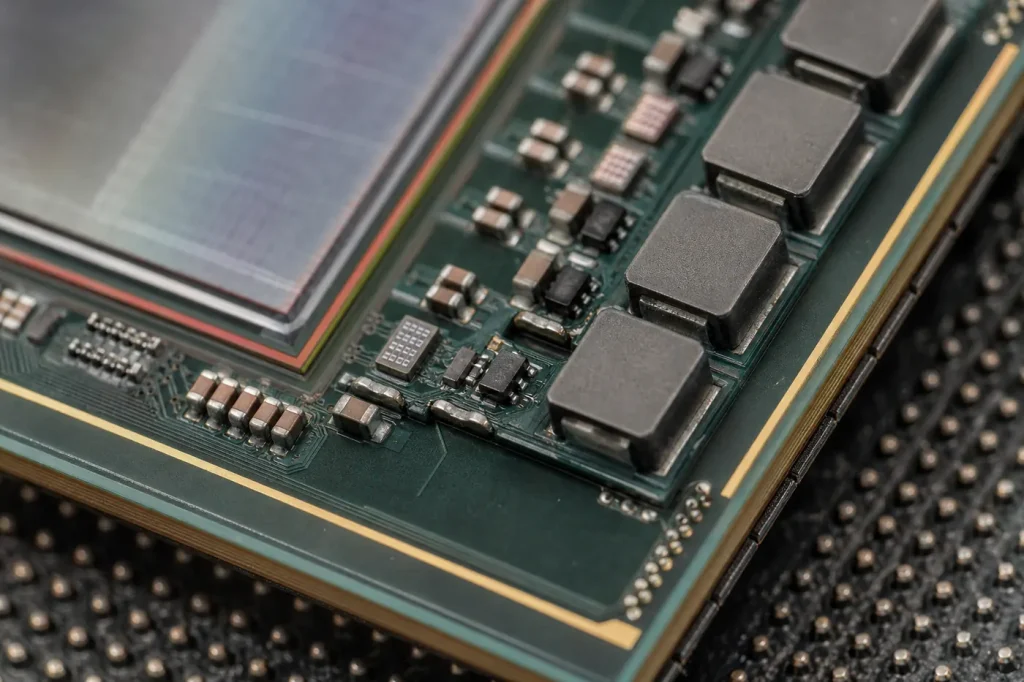
The last centimetre is the hard part. An AI accelerator core runs at well under 1 V while drawing hundreds to more than a thousand amps. Every milliohm of board and package resistance between the regulator and the die turns into I²R loss and voltage droop. An IVR moves the final conversion stage into or right beside the processor package, which shortens that path and lets the regulator respond faster to load steps. It is a different problem from bulk power conversion: the switches are low-voltage, the currents are very high, and the design constraints are area, inductor size and transient response.
It fills the bottom of onsemi’s power chain. onsemi is best known in wide-bandgap materials as a large supplier of silicon carbide power MOSFETs, used mainly at the high-voltage end, such as EV traction inverters and industrial drives. It is also one of the silicon partners NVIDIA lists for its 800 VDC rack architecture, which NVIDIA says starts rolling out in 2027. In that picture, SiC handles the high-voltage stages near the rack input, while IVRs handle the final step at the processor. Owning both ends gives onsemi a pitch that covers more of the conversion path from rack bus to die.
The middle stages are where materials compete. Intermediate conversion at 48 V and below is contested between silicon MOSFETs and gallium nitride HEMTs, which switch faster and shrink magnetics. Our SiC MOSFET vs Si IGBT comparison covers why SiC displaced silicon at high voltage; the same loss arguments now play out at the low-voltage end with GaN.
What we don’t know yet
- What revenue milestones trigger the extra $175 million, and over what period.
- Which processor customers, if any, have designed in Ferric IVRs. onsemi has not named them.
- Where Ferric parts will be manufactured after the deal closes, and whether onsemi will build them in its own fabs.
- How much of the raised $3 billion-plus 2030 target onsemi attributes to Ferric versus its existing SiC and silicon lines.
Sources
- onsemi newsroom, “onsemi to Acquire Ferric, Establishing Leadership in Power Delivery for Next-Generation AI Processors”, Nov. 2, 2026: https://www.onsemi.com/company/newsroom/news-and-insights/onsemi-to-acquire-ferric-establishing-leadership-in-power-delivery-for-next-generation-ai-processors
- onsemi, Form 8-K exhibit, SEC EDGAR, date not shown: https://www.sec.gov/Archives/edgar/data/0001097864/000119312526443681/d185557dex991.htm
- NVIDIA Technical Blog, “NVIDIA 800 V HVDC Architecture Will Power the Next Generation of AI Factories”, May 20, 2025: https://developer.nvidia.com/blog/nvidia-800-v-hvdc-architecture-will-power-the-next-Generation-of-ai-factories